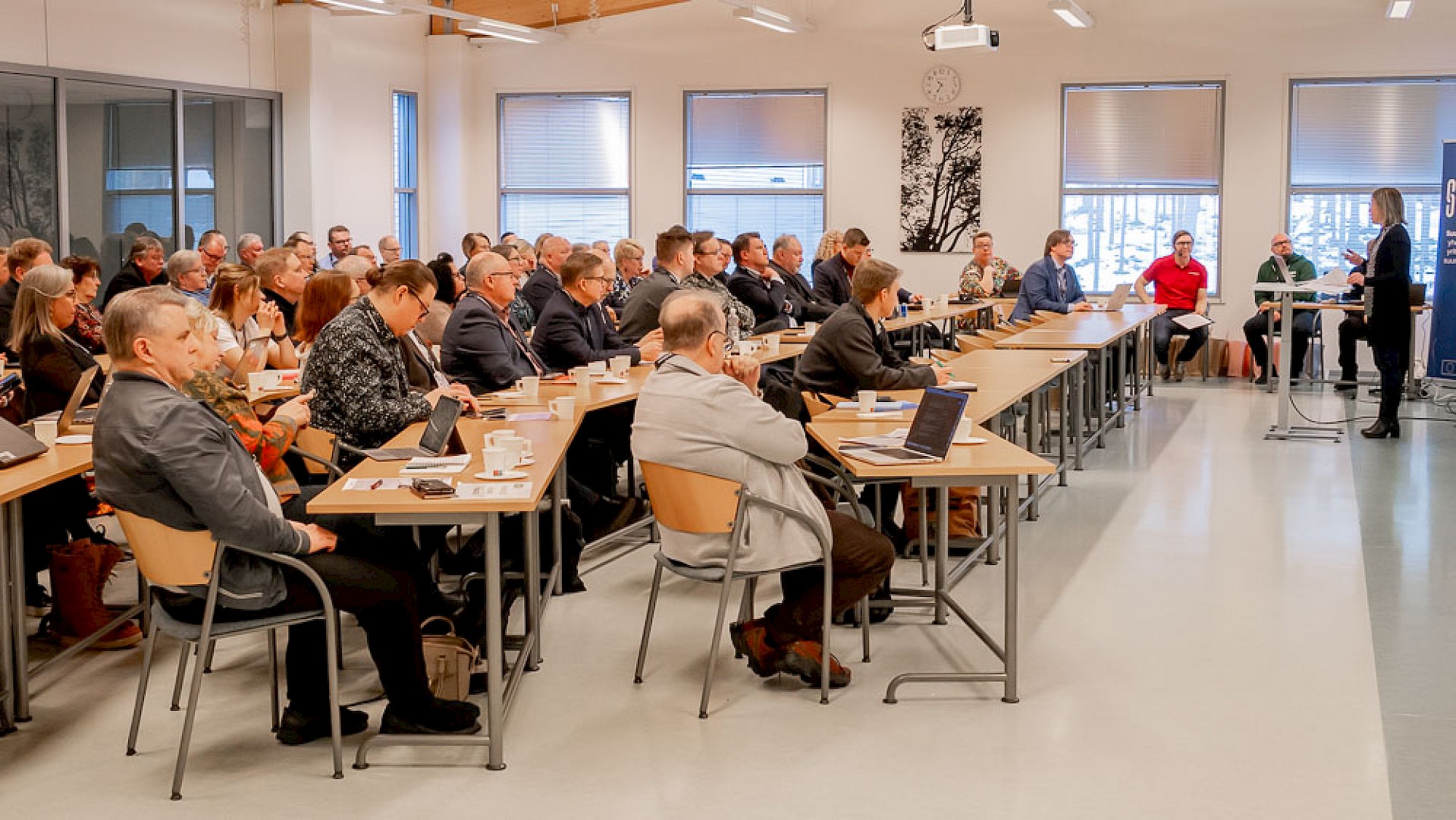
Kirsi Mukkala said that the scenarios of the external environment in Central Finland needed to be updated due to, among other things, rapid technological developments and digitalisation, such as ChatGPT, which she said came to the table more or less overnight. There was also a need to increase the emphasis on climate change and biodiversity loss.
The height pandemic, for its part, further concretised the interdependence of the world, putting health security at the centre, while Russia's war of aggression against Ukraine brought geopolitics right to the heart of the debate. The reform of the welfare regions and the transfer of TE services to municipalities are affecting the roles of actors and cooperation.
- As has been said here, anticipation is not prediction. That is why we have not tried to predict one most likely scenario, but it is essential to look at the totality of the scenarios and to better understand and structure the future and possible future developments," Mukkala said.
The scenario work resulted in three scenarios for Central Finland; the rise of corporate power and the return of class society, a balancing act in a bipolar world and Nordic cooperation in a declining Europe.
Scenario 1
- The first scenario is thought to be a scenario of strong global consensus and stable development, which currently seems rather distant. It would see the removal of trade barriers, relatively stable global economic growth and, for example, successful climate change mitigation led by big business. Conversely, technological progress has been rapid and the need for human labour has declined across the board, and not everyone will find their place in a modernising working life," Mukkala said, picking out examples from the scenario.
For Central Finland, the scenario could mean that we have seen a lot of business failures, but a certain number of companies have been able to capture the suction of global corporations. The bio- and circular economies have strengthened, radical technological developments have led to an emphasis on cyber skills, and this is where Central Finland has made its mark. Teaching, training and research would be carried out in closer cooperation with businesses. Unemployment would remain high in Central Finland and work would be highly polarised. The scenario is highly concentrated and the current structure of municipalities does not exist. Nature and cleanliness would continue to be attractions.
Scenario 2
- The second scenario is a strongly global blocking scenario, where the gap between democratic and authoritarian states has widened. The West is relatively united and the EU is strong. China's aspirations for power are big and are viewed very critically in the Western world. There is a huge investment in defence, and Western defence cooperation is strong. Climate change is advancing because there is no global cooperation to slow it down," Mukkala said, opening the second scenario.
In this scenario, Central Finland's cyber and defence industries are very strong, which has brought high-skill companies to the region and supported employment. EU funding has been successfully implemented in the region, but on the other hand, the strong steering influence of the EU does not serve the interests of everyone in the region. Extreme weather events are less frequent than elsewhere, which has benefited the tourism sector in Central Finland, for example. Overall, this is a scenario of unstable development, but it is not as concentrated as the first scenario. Outside the growth triangle, there are successful cities.
Scenario 3
- The third scenario is clearly a scenario of a fragmented, conflict-prone world. The foundations of democracy have been eroded in many countries, and authoritarian models of governance are gaining ground. The United States has turned its back on Europe and is waging its own battle against China. China has clearly moved to the forefront of the international scene, with a very strong influence in various sectors of society. Chinese surveillance systems have also spread to Europe, and our privacy is crumbling. Europe has turned inwards, the EU has weakened and Member States have left it. The Nordic countries have become Finland's most important frame of reference. In the absence of much global cooperation, the planet is heading towards uncontrolled global warming.
In this scenario, business exports and trade in Central Finland will be concentrated at home and in other Nordic countries. Green investment is quite successful, and re-industrialisation has boosted activity in the wider region, including in more remote areas. Artificial intelligence has not replaced human labour on a large scale, and much of the work has remained local. The emphasis on the importance of security of supply underlines the importance of agriculture and food production in general. On the other hand, difficult weather conditions are challenging agriculture in the region. There is a strong sense of inequality in society, which is exacerbated by insecurity and increased family responsibility for those close to them.
Regardless of how the different scenarios play out, Mukkala says it is essential to ensure the attractiveness of the region.
- In addition, we need to create a framework for a growing economy and to nurture and develop skills. It is also important to be active in the green transition, to support sustainable lifestyles in people's daily lives and to ensure people's participation and community.
A centre of vitality for Central Finland as a whole
At the beginning of 2026, ten new centres of vitality will start operating. They will take on tasks related to, for example, business, rural areas, transport, the environment and natural resources. Jukka Lehtinen, Director General of the Centre for Vitality in Central Finland, said that the centres play a key role in regional development and cooperate with other actors in the region.
- Before the change, the state authorities in regional administration were the Regional State Administrative Agencies and the ELY Centres. The political will had long been to get the wheels turning in this country, with a clear link to various licensing and business promotion. The solution was seen to be to pool certain resources in a national agency, harmonise and make the same type of decisions everywhere. The centres of vitality were left as the only regional administration in the regions, which means that we are working in the cap of Suomi Oy. I myself acted as a government representative here as a statesman," Lehtinen explained the reform.
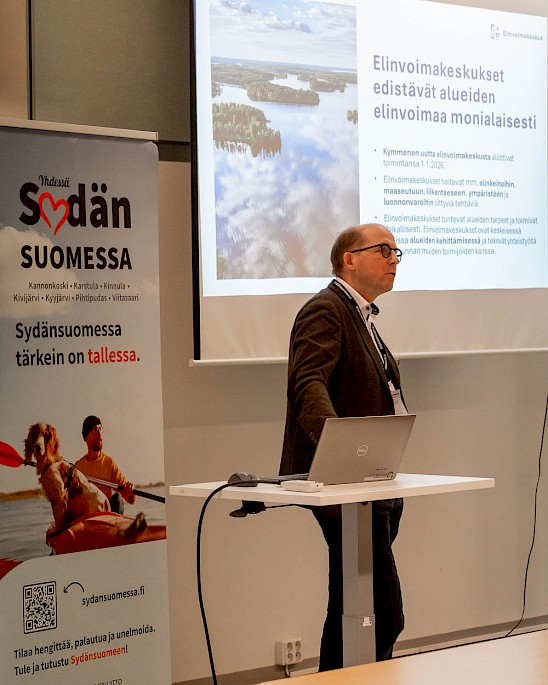
The tasks and services of the Centre for Vitality in Central Finland include helping businesses to succeed, strengthening the conditions for working life, safeguarding the vitality of rural areas, keeping the wheels turning, for example by taking care of road maintenance and upkeep, and looking after the environment.
- As a region, Central Finland is grateful to us for our efforts. We know the region well and geographically Central Finland is such that we can get to many places. Our vision is to create a sustainable future together and close to home, and cooperation is the story here. We need cooperation and trust within the regions in the centre of vitality. We hope that we are worthy of trust and that we can carry the message of how things are really going in this region. The clear strength of working locally is that we have a realistic overview of where Central Finland is going.
The vitality centres also produce a lot of information that can be used, for example, by the region's lobby, as the vitality centres are not lobbyists.