
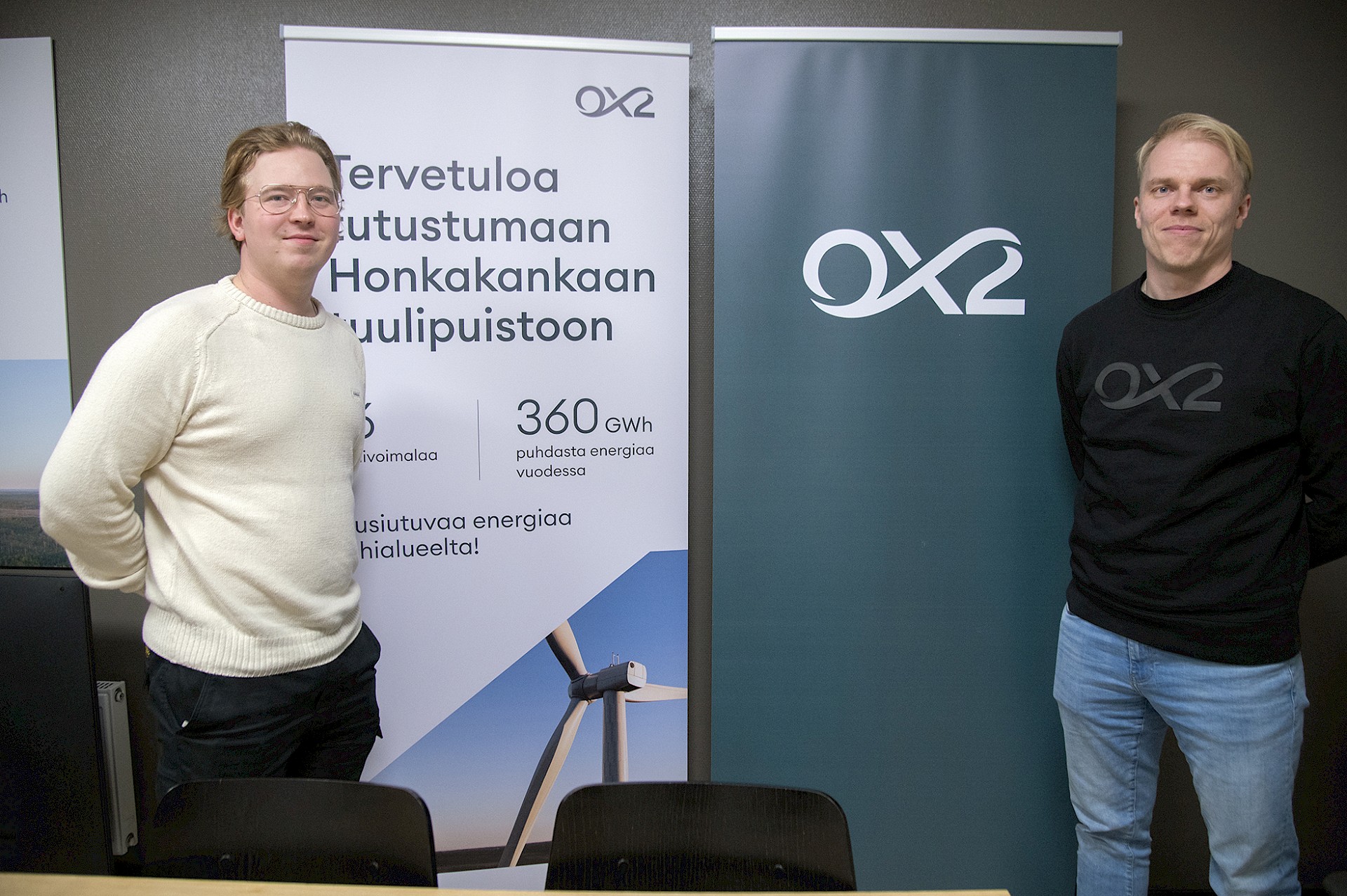
Although wind power investment in Finland almost came to a complete halt in 2025, Finland's largest wind power developer OX2 continues to invest. Its wind power projects, such as the Honkakangas wind farm, are bought by the online trading giant Amazon, which in turn sells the electricity on the Finnish market. The wind farms in question are owned and operated by OX2.
Honkakangas consists of 16 wind turbines with a total capacity of around 105 MW. The total height of a single turbine is 250 metres. To transmit the electricity from the wind farm, a 400 kilovolt transmission line will be built from the Honkakangas substation to Fingrid's Halsua substation. According to project manager Markus Luukkonen, the project is expected to be completed by the end of 2026.
Once Honkakangas is completed, the wind farm will be temporarily connected to the 400-kilovolt power line of the grid company Fingrid via a cross-connection. This will be the first temporary connection of a private operator to the 400 kV Fingrid transmission line. The solution will be in use until the completion of the Halsua substation, which is still under construction by Fingrid.
The Kannisto wind farm will consist of 20 wind turbines with a combined capacity of 124 MW. The wind turbines in Kannisto will also be 250 metres high. The electricity transmission will be carried out by a 400-kilovolt transmission line from the project area via Honkakankaan substation to Halsua substation. Construction of the wind farm is underway and the wind farm is due to be completed in 2028.
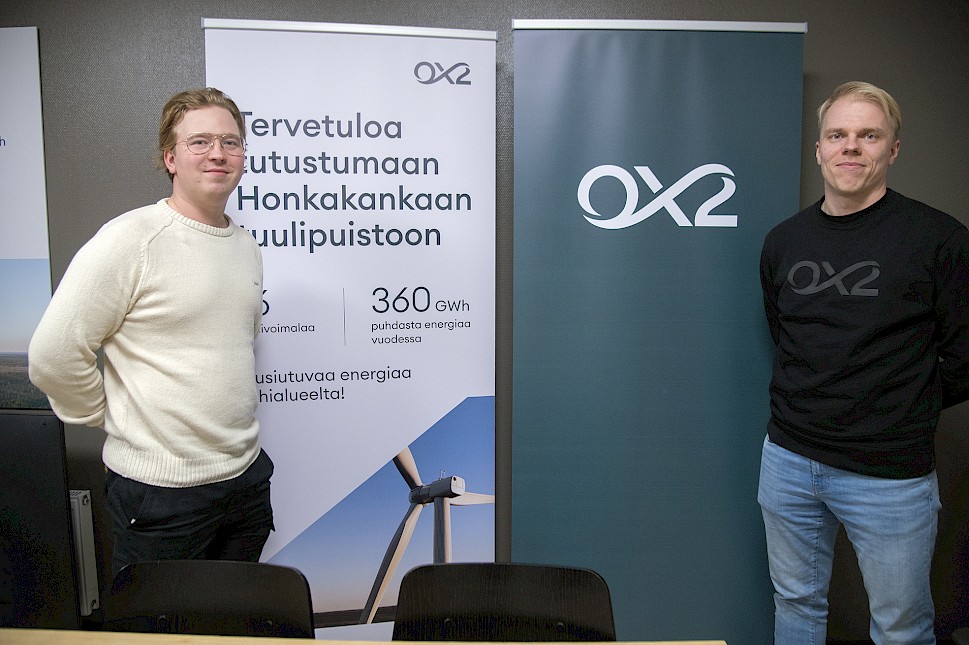
Work on the Honkakangas wind farm has progressed in good cooperation with the local community," say Project Manager Markus Luukkonen (left) and HSE Coordinator Jussi Jurmu. Photo by Jorma Uusitalo
Good coexistence with the locals
OX2's office is centrally located in the centre of Halsua in the Kotikuluma property. It is therefore easy for wind energy developers to catch up with the locals.
- We've been very well received here since we started working with the municipality to make the practical arrangements. Our principle is openness, and I believe that this is one of the reasons for good coexistence with the local residents and forest owners, for example," says Markus Luukkonen.
For municipalities, wind power projects are known to bring jobs and tax revenue. In the Honkakangas project, OX2 has had around 15 subcontractors, and Luukkonen estimates that between 150 and 200 people have worked on the wind farm. In addition, there will be various indirect effects.
- The online service Suurhanketoimisto.fi has been a great help on many points. It has made it easy to find information on contractors, accommodation services and places to eat, for example," says Luukkonen.
He says that the Honkakangas wind farm site has found space for both people and animals. Mobile phone cameras have been useful when it has come to deer with calves, moose or wild ducks.
Safety always comes first
When it comes to safety, OX2 has set the bar high, whether it's safety at work or environmental safety. Jussi Jurmu, HSE coordinator on the Honkakankaanka project team, says that even before starting a new project, OX2 draws up internal codes of conduct, which contain not only guidelines but also requirements and reminders, for example. Once the contractors have been selected, OX2 goes through the safety-related documentation sent by the contractors and ensures that they meet the requirements set by the client.
- In practice, OX2's safety requirements are stricter than the legal minimum, Jurmu emphasises the high standards of OX2's safety culture.
When you look at wind energy construction in general, the biggest hazards are largely related to movement. An ankle has been sprained in the terrain, a slip on the slippery stairs of the site barracks or a finger has been cut.
- If we assess the biggest risks that could materialise, they are particularly related to workplace traffic. When 200 people come to a project site to learn the ropes, accidents can happen. Of course, there are also risks associated with lifting turbines and working at height and in a live environment, for example," says Jurmu.
Work at Honkakankaa has also progressed in the best possible way from a safety point of view, as there have been no accidents resulting in absence from work, nor any that would have led to hospitalisation.
Wind power and the deer protection zone
Wind power is the fastest way to increase domestic renewable electricity production. However, the current uncertainty surrounding wind power projects is the five-kilometre protection zone for woodland deer. This is the view of the Finnish Natural Resources Institute (Luke) that in important breeding areas for wood deer, and especially in Natura areas, an undeveloped five-kilometre protection zone should be left for wood deer.
The extent of the protection zone has been said to be both excessive and overcautious. The wind industry fears that the current extent of the protection zone will lead to the watering down of wind farm projects, or at least to a reduction in their size. The situation is particularly difficult in Central Ostrobothnia, where wind conditions are very favourable for the use of wind power in energy production.
Heli Harjula, who works as a project manager at OX2, has also noticed that nowadays, many projects are confronted with the deer as early as the planning stage. Despite the fact that the wood deer is not a strictly protected species, she says that the impact of a wind power project on the wood deer is practically always assessed in the EIA procedure and during the planning process if the project area is located in a wood deer habitat.
- At present, it seems that the five-kilometre protection zone is categorically maintained. Our view is that the assessment of the impact of construction on the forest deer should be based on an expert assessment, and each project should be dealt with on a case-by-case basis," says Harjula.
One problem is that only Luke has access to more accurate GPS data on the presence of woodland deer populations. The one-size-fits-all five-kilometre policy has also been questioned because forest deer have been seen moving around even in wind farms under construction.
Mr Harjula also points out that the five-kilometre protection zone poses problems for the electrification of society in general, because in addition to wind farms, the five-kilometre protection zone also affects transmission line projects.
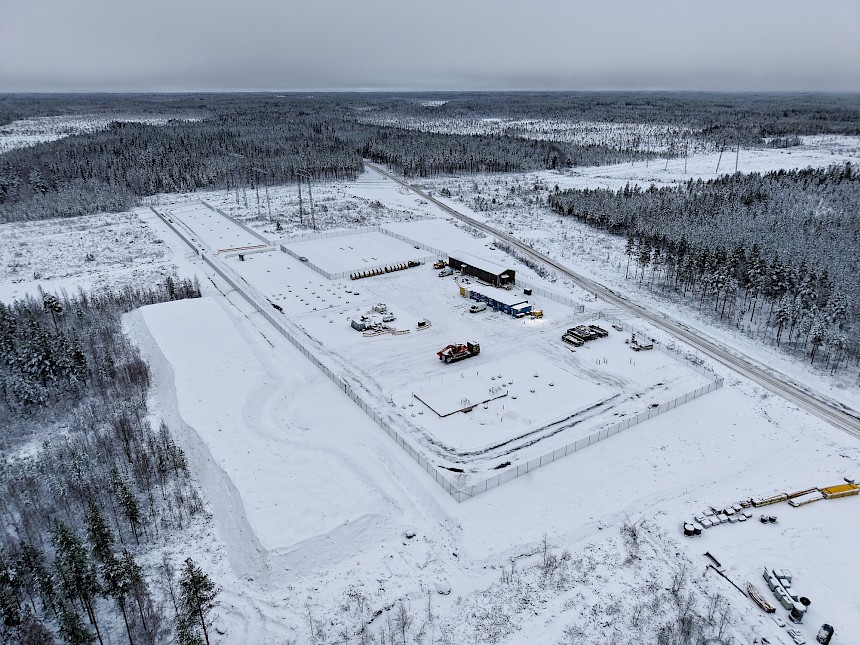
The installation of wind turbines at the Honkakangas wind farm will start in spring 2026. Photo: Henry Haataja, Enerquest Oy