
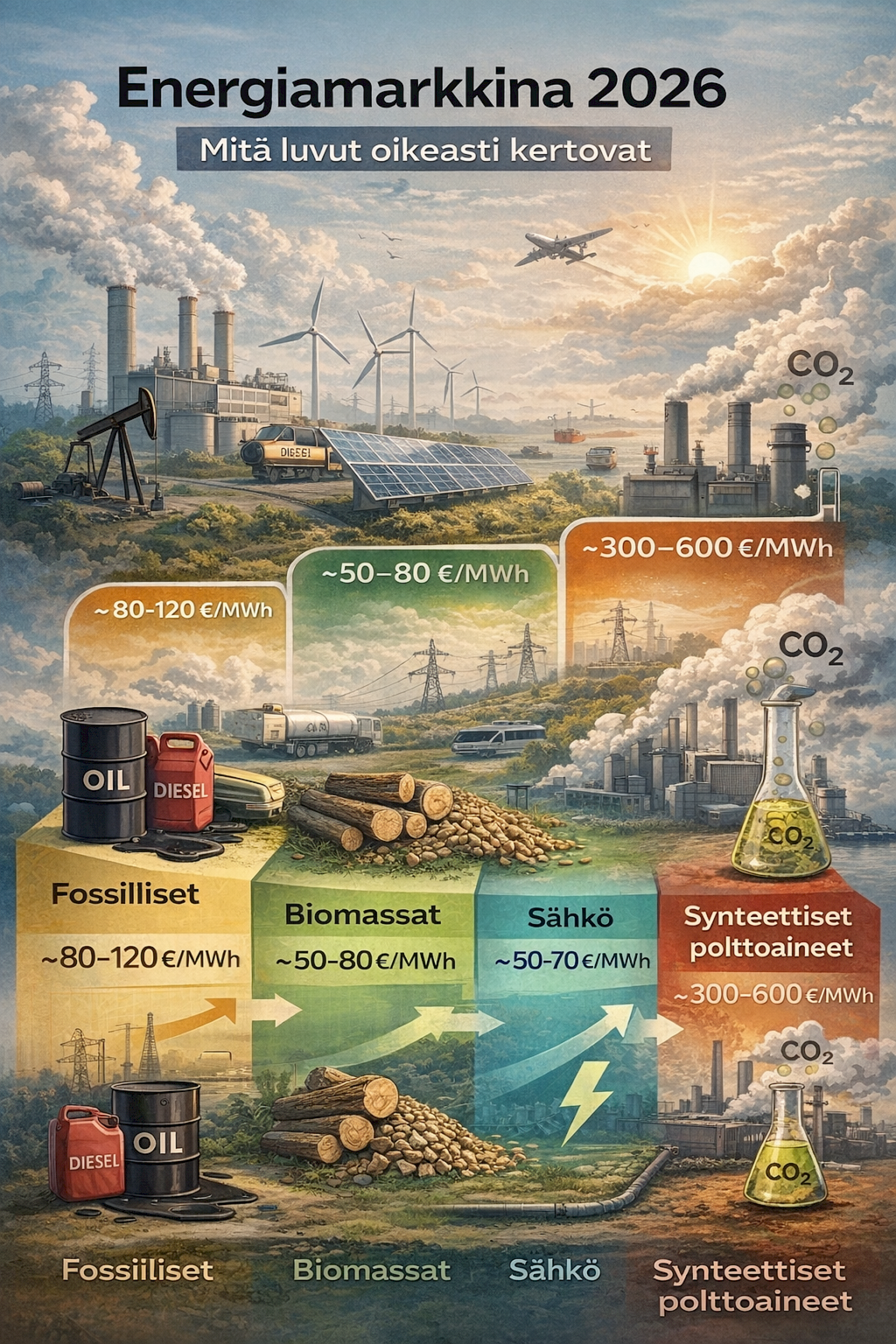
When the different forms of energy are converted into the same unit, euros per megawatt-hour, the energy market quickly becomes clear. In 2026, the big picture is no longer a blurred transition, but a structure that is visible: we know what is cheap, what is expensive and where the options end.
Fossil fuels will continue to determine the price level. The energy price of diesel and petrol will be around €80-120/MWh, which in practice will serve as a benchmark for the whole market. Natural gas will remain well below this, at around €40-50/MWh, and coal even lower, although its use will be limited for reasons other than price. This simply means that fossil fuels have been removed from the market not for economic reasons, but because there is a desire to replace them.
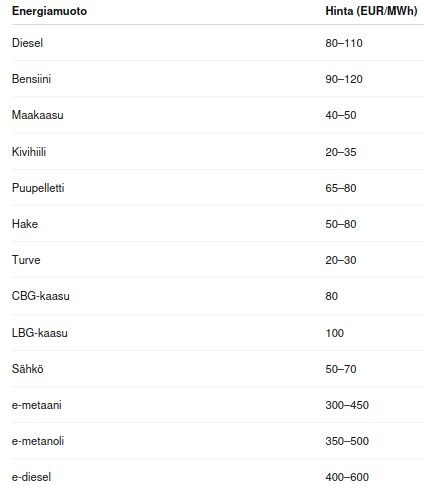
Energy market 2026 - price comparison, EUR / MWh
Biomasses are in the same cost category as fossil fuels. Wood pellets and wood chips are realistically around 50-80 €/MWh, which makes them directly competitive, especially for heat production. However, this is where a physical limitation comes in: biomasses are not infinitely scalable. Limited by availability, logistics and feedstock quality, their role will inevitably remain complementary, not system-defining.
Electricity clearly stands out in a class of its own. At around €50-70/MWh, it is the cheapest form of energy when it can be used directly. It is not just the price but the efficiency that counts: electricity can be used without modification, thus avoiding additional costs. This leads to a simple trend - anything that can be electrified sensibly will be electrified. This is not a political choice, but the result of a straightforward logic of cost and efficiency.
It is with synthetic fuels that the realities of the energy market become most apparent. Prices for e-methane, e-methanol and e-diesel will be around €300-600/MWh in 2026, many times higher than for fossil fuels or electricity. This is not due to a market failure but to the production chain. Electricity is first converted into hydrogen, then combined with carbon dioxide and finally refined into fuel. Each step entails losses and costs, and there is no getting around this basic physics. The price of electricity is a key variable, but it does not solve the problem on its own. Even if electricity is cheap, the efficiency of the overall process remains so low that the price of the final product is inevitably high. This is compounded by investment costs, carbon capture and the complexity of production. For this reason, synthetic fuels will not compete on price, but their role will emerge by necessity. Applications will be found in sectors where electricity is not a realistic alternative, such as aviation, maritime transport and certain industrial processes.
The overall picture is ultimately quite straightforward. Electricity is the preferred solution where it works. Biomasses are complementary, especially for local use. Fossil fuels continue to set the price level against which others are compared. Synthetic fuels will only come into play when there are no other alternatives.
The energy transition is therefore not about replacing one technology with another, but about optimising the system. The cheapest and most efficient energy is always used first, with more expensive solutions filling the gaps that cheaper alternatives simply cannot fill.
This article has been created using artificial intelligence.