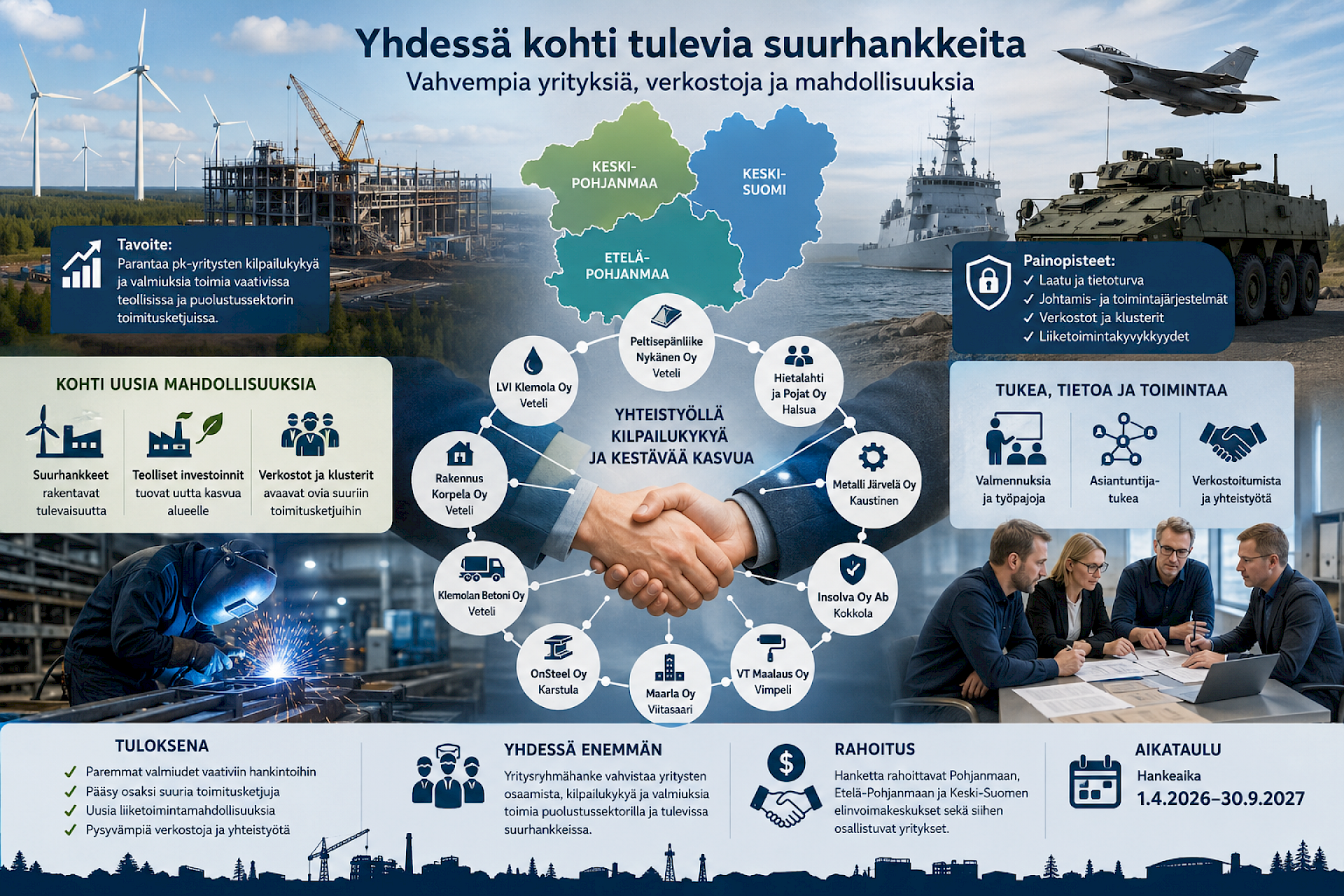
The operating environment for many subcontracting companies in the region is changing as the construction phases of major projects come to an end. The construction phase of the Sibanye-Stillwater Keliber lithium mining project is complete and the mine and its concentrator are about to start. Finland's largest wind power project, OX2 Lestijärvi, has also been completed and handed over to the owners. Other projects still in progress include the Halsua Honkakangas and Kannisto wind power projects of OX2. The main subcontracting and employment impacts following the decision to start lithium mining will be mainly related to extraction, earthmoving and transport. Several subcontracting companies in the region are about to be deprived of a major major project employing the wider subcontracting chain.
In a changing and opportunity-rich context, companies need to develop their skills, business models and networks to respond to new business opportunities. The project will develop their management and operational systems, and through a coaching approach, improve their business capabilities. The project aims to improve cooperation between companies through networking, and to create a cluster approach to improve companies' access to large industrial projects. The development work will take the form of company-specific and joint training, expertise and networking activities.
A key focus of the project will be the development of transnational subcontracting networks and a functioning cluster of companies to improve the risks and challenges associated with capacity shortages. The cluster project involves companies from three provinces:
-
Peltisepänliike Nykänen Oy, Veteli
-
LVI Klemola Oy, Veteli
-
Hietalahti ja Pojat Oy, Halsua Hietalahti and Sons Ltd.
-
Hietalahas and Huttala Hutahalja Oy, Vetalli Järvelä Oy, Kaustinen
-
Insolva Oy Ab, Kokkola
-
Rakennus Korpela Oy, Veteli
-
Klemola Concrete Ltd, Veteli
-
OnSteel Oy, Karstula
-
Maarla Oy, Viitasaari
-
VT Maalaus Oy, Vimpeli
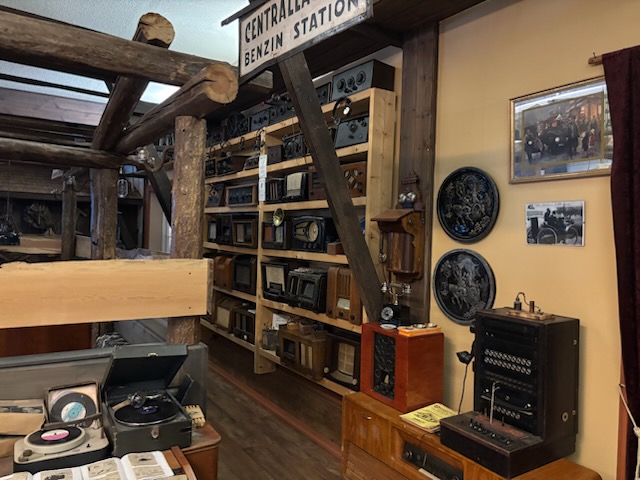
The Kick Off of the Growth Pillars business group project was held on 6 May at Wanhoe Wehki in Karstula. Photo.
The group of companies offers top quality and security of supply to Patria.
The defence industry is a growing and strategically important business environment for Finnish companies, further strengthened by NATO membership and the defence sector's expanded procurement models. However, many companies do not have sufficient capabilities, operating models or networks to enter defence procurement and supply chains. Challenges include defence quality requirements, the right contact channels, shortcomings in companies' production capacity and skills gaps in responding to complex bidding rounds.
Major projects of interest to the companies in the group include those being launched by Patria. The Group has 175 MWT worth of state-of-the-art capacity and subcontracting resources to offer Patria, and when added to the Group's own subcontracting networks, there is significant defence cluster expertise internationally. Network building is therefore one of the key objectives of the Group project. Cooperation will be established with other important cooperation networks such as the Kokkola Maritime Cluster and Savo Defence. The information channel and horizontal platform for the Pillars of Growth project is the suurhanketoimisto.fi service developed in previous projects, where the ERP service provides the resources of more than 330 companies to implement even the most demanding projects.
Arctial's low carbon aluminium project
In recent years, the activities of several subcontracting companies in the region have relied heavily on major projects in the surrounding area. The construction phase of the Sibanye-Stillwater Keliber lithium mining project and the OX2 wind power projects have employed in particular construction, metal and industrial subcontractors. With the completion of the construction phase of the Keliber lithium mining project and the completion of the wind power projects, the business environment for companies in the region will change substantially.
One of Finland's largest investments is under way in the surrounding area: Arctial's low-carbon aluminium production plant. In addition to Arctial, there are other major industrial investments in Finland and the surrounding area in the preparation and planning stages, and the construction phase is expected to start. The experience of the sub-region with the Keliber Oy and OX2 projects shows that smaller subcontracting companies need coordinated action and assistance to enter the subcontracting networks required for large projects.
The project will develop cooperation networks and the capacity to respond to demanding tendering and procurement processes
As a result of the project, companies will be better equipped to respond to demanding tendering and procurement processes, to operate as part of wider supply chains and to exploit new business opportunities. The project will also create more sustainable cooperation and networking structures that will support the renewal of the region's economy.
The companies participating in the cluster project will be the main development partners of the project. They will actively participate in project activities such as joint and company-specific training, development workshops, networking and cluster cooperation. They will bring their own business needs, competences and areas for development to the project. The transnational cooperation will enable the creation of new business clusters and provide complementary skills for the cluster companies.
The enterprises participating in the cluster project are also the targets of the project's development activities. Although the project is applied for and managed by the Kaustinen sub-regional municipality, public aid is granted to the participating enterprises as de minimis aid. The enterprises will benefit from the enterprise-specific and cluster-level development measures implemented in the project. The contribution of the enterprises participating in the group project will be 25% of the total project costs, of which the individual contribution will be EUR 5 500. There is no municipal contribution to the project. The main financial backers of the project are the centres of vitality of Ostrobothnia, South Ostrobothnia and Central Finland and the participating companies. The Enterprise Group Project is a project carried out by the Kaustinen sub-regional municipality in cooperation with the enterprises participating in the Enterprise Group Project. The project period is 1.4.2026-30.9.2027
The official information channel for the project during the project period is suurhanketoimisto.fi. The project is co-financed by the European Union.
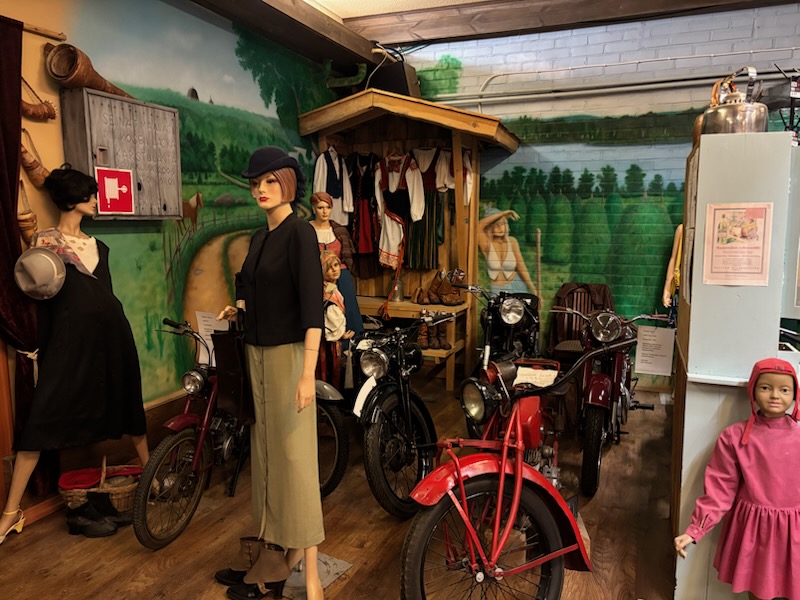
Research has shown that the success of events is largely determined by the setting of the venue. For a dose of nostalgia as a source of inspiration, Karstula's Wanhoe Wehki is the place to be.